
SORBO (2025)
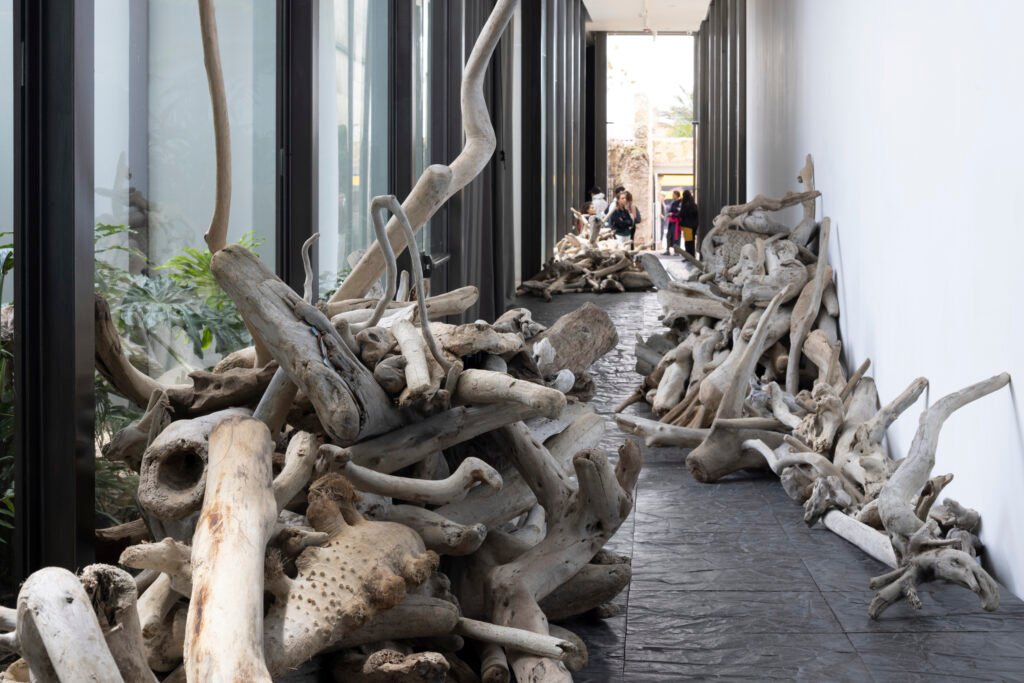
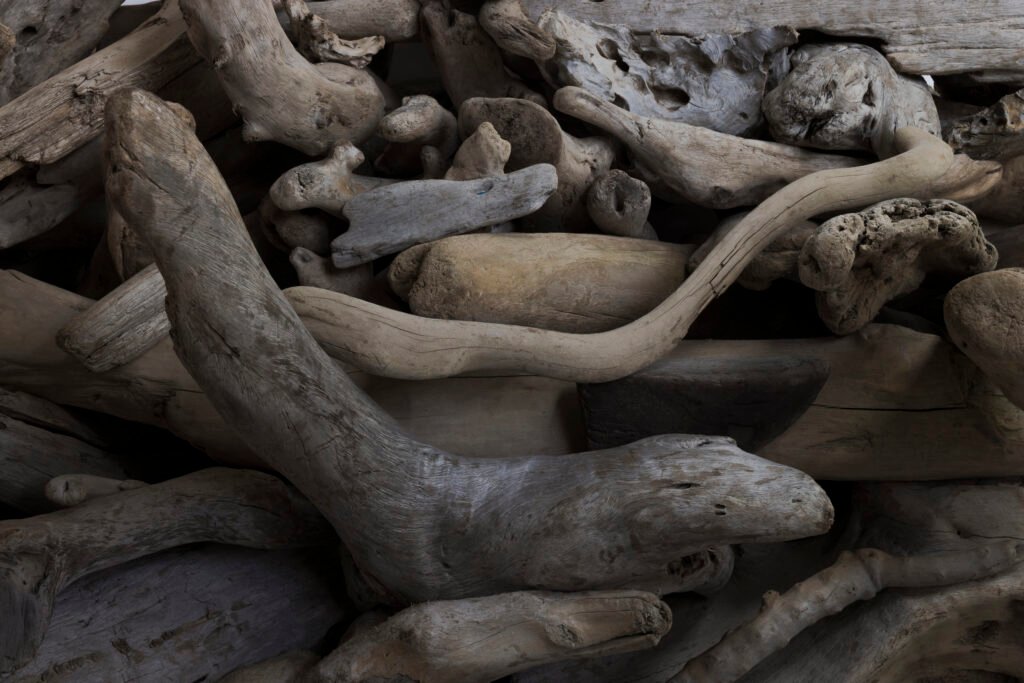
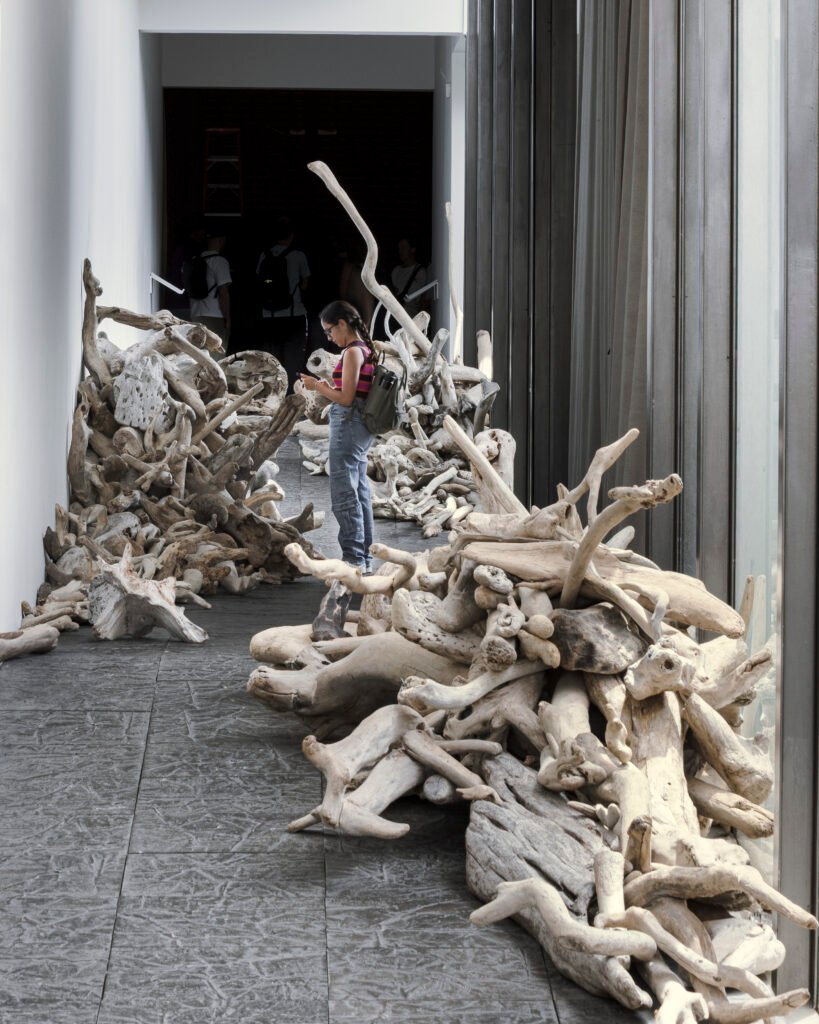
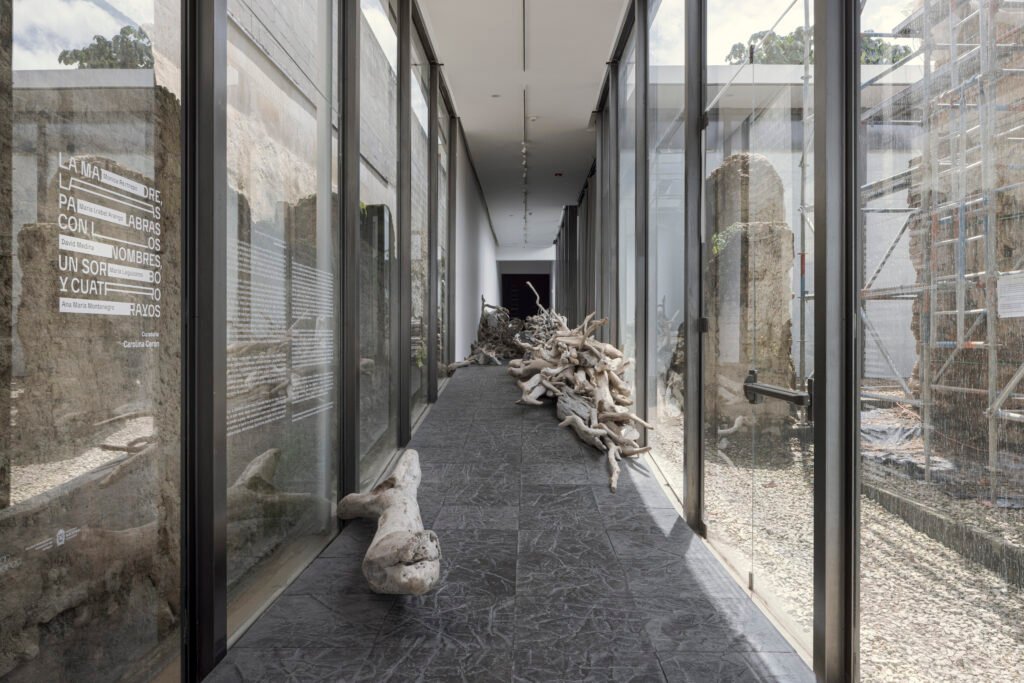
Madera náufraga recolectada en el Río Magdalena y sistema de sonido táctil
“La madre, las palabras con los nombres, un sorbo y cuatro rayos”
Curaduría de Carolina Cerón
Fragmentos, Espacio de Arte y Memoria, Bogotá
El río zumba cuando se crece porque trae palizaá. Tú sabes que yo siempre he estado interesada por los procesos de erosión, sobre todo los que tienen que ver con acciones humanas. Hay algo que me conmueve profundamente de las transformaciones radicales que ocurren en una escala temporal que todo lo vuelve blando, conmovible al tiempo. Todo se puede cambiar si tienes paciencia. El cuerpo de agua del Río Magdalena no es propiamente una fuerza erosiva humana y lo que estoy buscando es construir esa narrativa, que sí es, porque además la vida del río atraviesa la vida humana de formas muy complejas. Por supuesto, esto lo sabes, los cuerpos de personas desaparecidas permanecen en el río y anda así, atravesado por la violencia. Es a la vez, la posibilidad de la vida y la transformación constante. La promesa de que todo cambia. Seguro conoces esa frase que dice que no se entra en el mismo río dos veces. Es una ironía quererlo atrapar, solidificarlo y suspenderlo en una imagen. Te quiero contar que la vibración del caudal tiene una correspondencia directa con el resultado material. Estos palos, ya lo sabes porque lo ves, son esculturas que el río ha construido con su voz. No existe un solo río, ni una sola voz. He estado pensando en las propiedades acústicas de la madera, como todos los instrumentos, bueno, muchísimos instrumentos, están construidos de madera, ese material duro y blando al mismo tiempo. Por eso es muebles, casas y ataúdes. Se deja moldear relativamente fácil, pero mantiene su forma rígida. Esta es la base rítmica de un armazón acústico.
Las pulsaciones subyacentes de las grabaciones junto con sonidos de voz, de aire, producen los movimientos. Sí, así. Un movimiento, como decíamos, es esa cosa táctil que nos toca. La erosión sí es del agua, es la vibración del agua con todo lo que arrastra. La vibración viene del caudal de las aguas del río. El sonido que emite se modifica de acuerdo a lo que carga, de acuerdo a su equipaje. Entonces, ya sabrás, esa es la variable que hace que la vibración sea una y no otra. Esa. Los palos empiezan a asumir las formas del agua como las huellas de todas las imbricaciones. Entonces esto es el retrato de una voz, una voz abstracta, honda y complicada. La canción El Arroyo de Pabla Flores, habla de cómo el río zumba, cómo el río suena cuando trae palos. Y no sé si sepas, que así es como se sabe cuándo el río está crecido, a través del zumbido que produce la palizaá, que es la acumulación de madera náufraga. También te he contado que siempre suena. La canción de Willie Colón me ha acompañado tanto en esta búsqueda… “las palabras son de aire y van al aire, las lágrimas son agua y van al mar”. Suena en todos los puertos.
Repetimos: estamos conectados por la misma naturaleza oscura y caótica que nombra y moldea las huellas del agua en los árboles caídos, en las ramas, en lo que ya no vive y se cae al río. Es la poesía del río que hace con sus brazos el modelado de la madera, que le quita lo que sobra, que lo lija y lo pule en un ritmo encarnado y ciego. Pregúntale al agua como es que vive con esa ceniza. Hay que oír esa insurrección. Repetimos. Es una maravilla que a través del agua nos lleguen esos rastros, como voces, como gritos, como latidos, como lijas, como osamenta. Es el canto del agua que conjura las ganas de dejarse moldear por ella. Es el bramido del río. No sé si ya sabes que lo quieres oír. Que lo quieres tocar. Aquí se oyen voces saliendo de lo que no se mueve. Repetimos. Estas son las huellas de la vibración del agua sobre la madera. El canto que oye la madera está en ella misma. El agua solo se la saca. Esta es la huella de la voz del agua. Es la huella del susurro. Los instrumentos que son agua, cantan sobre los cadáveres de los árboles, el origen del canto es el de los cuerpos rotos. Repetimos: para cargar el peso del agua. Repetimos. Estos huesos son, a la larga, lo invencible de la naturaleza. La presencia capturada. El silencio es solo una pausa. Estos árboles son solo los testigos. Estos árboles son la alegría de lo ruinoso. Si lo atrapas, lo sofocas.
Carlina Cerón y María Leguízamo
The river hums when it swells, because it carries palizaá. You know I’ve always been drawn to processes of erosion—especially those shaped by human action. There’s something that moves me deeply about those radical transformations that unfold in a temporal scale that softens everything, makes it all tremble over time. Everything can be changed if you wait long enough. The body of water of the Magdalena River is not, strictly speaking, a human erosive force, and what I’m trying to build is that very narrative—that it is. Because the life of the river runs through human life in complex, entangled ways. Of course, you know this: the bodies of the disappeared remain in the river, carried along by violence. It is, at once, the possibility of life and the promise of constant transformation. The promise that everything changes.
You’ve probably heard that phrase: you never step into the same river twice. It’s a kind of irony, this urge to trap it, to solidify and suspend it in an image. I want to tell you that the vibration of the current has a direct correspondence with the material outcome. These sticks—you see it, you know it—are sculptures the river has built with its own voice. There isn’t a single river, nor a single voice. I’ve been thinking about the acoustic properties of wood, how so many instruments are made from it—that hard and soft material at once. That’s why it becomes furniture, houses, coffins. It yields easily, yet holds its shape. That’s the rhythmic base of an acoustic frame.
The underlying pulses of the recordings, together with the sounds of breath and air, make the movements happen. Yes—like that. Movement, as we said, is that tactile thing that touches us. Erosion belongs to the water. It’s the vibration of the water with all it drags along. The vibration comes from the river’s flow. The sound it emits shifts with its cargo, with its baggage. That’s the variable—the reason the vibration becomes one thing and not another. The sticks start to take on the shapes of the water, as if etched with the traces of every entanglement. This is a portrait of a voice—an abstract, deep, complicated voice. The song “El Arroyo” by Pabla Flores speaks of how the river hums, how it sounds when it carries wood. And maybe you know this: that’s how people tell the river has risen—by the hum of palizaá, the drifting wood’s accumulation. I’ve told you before: the river is always singing. The song by Willie Colón has followed me all through this search: “Words are made of air and go to the air, tears are made of water and go to the sea.” It plays in every port.
We repeat: we are connected through that same dark, chaotic nature that names and shapes the marks of water on fallen trees, on branches, on what has died and fallen into the river. It’s the river’s poetry, sculpting with its arms, stripping away what’s unnecessary, sanding and polishing in a blind, embodied rhythm. Ask the water how it lives with that ash. You have to hear that insurrection. We repeat. It’s a marvel how, through water, these traces reach us—like voices, like cries, like heartbeats, like sandpaper, like bone. It’s the song of the water conjuring the urge to be shaped by it. It’s the river’s roar. I don’t know if you know it yet—but you want to hear it. You want to touch it. Here, voices rise from what doesn’t move. We repeat. These are the marks of water’s vibration on wood. The song the wood hears is within itself. The water only draws it out. This is the imprint of the water’s voice. The imprint of a whisper. The instruments that are water sing over the corpses of trees. The origin of the song is the broken body. We repeat: to bear the weight of water. We repeat. These bones are, in the end, nature’s invincible. Captured presence. Silence is only a pause. These trees are only witnesses. These trees are the joy of ruin. If you trap it, you smother it.
Carlina Cerón and María Leguízamo
Fotos y video por Oscar Beleño
Cortesía de Fragmentos, Espacio de Arte y Memoria – Museo Nacional de Colombia.